Are They Allergies — Or Your Hormones?
One of the most rewarding things we see at Ourself is the moment someone connects their symptoms back to their hormones, patterns they may have sensed for years, finally showing up as data they can point to.
Why the Science on Women's Health Is Often Incomplete
The science behind those patterns often exists in some format. It can be fragmented, under-studied, or buried in places most people will never see. In women's health especially, entire questions have simply never been asked, or only answered in small, scattered ways, leaving huge gaps in what we know. So even when pieces of the science are there, they often don't add up to the kind of clear, practical guidance women actually need.
When Seasonal Allergies Aren't Just Allergies
Allergies are a perfect example, and with spring in full swing, a timely one.
Every year, millions of women reach for antihistamines and assume their symptoms are just… allergies. Some are. But for many, what looks like seasonal allergies may be hormonally influenced, something the scientific literature has been suggesting for a long time.
The Estrogen-Histamine Link Isn't New Science
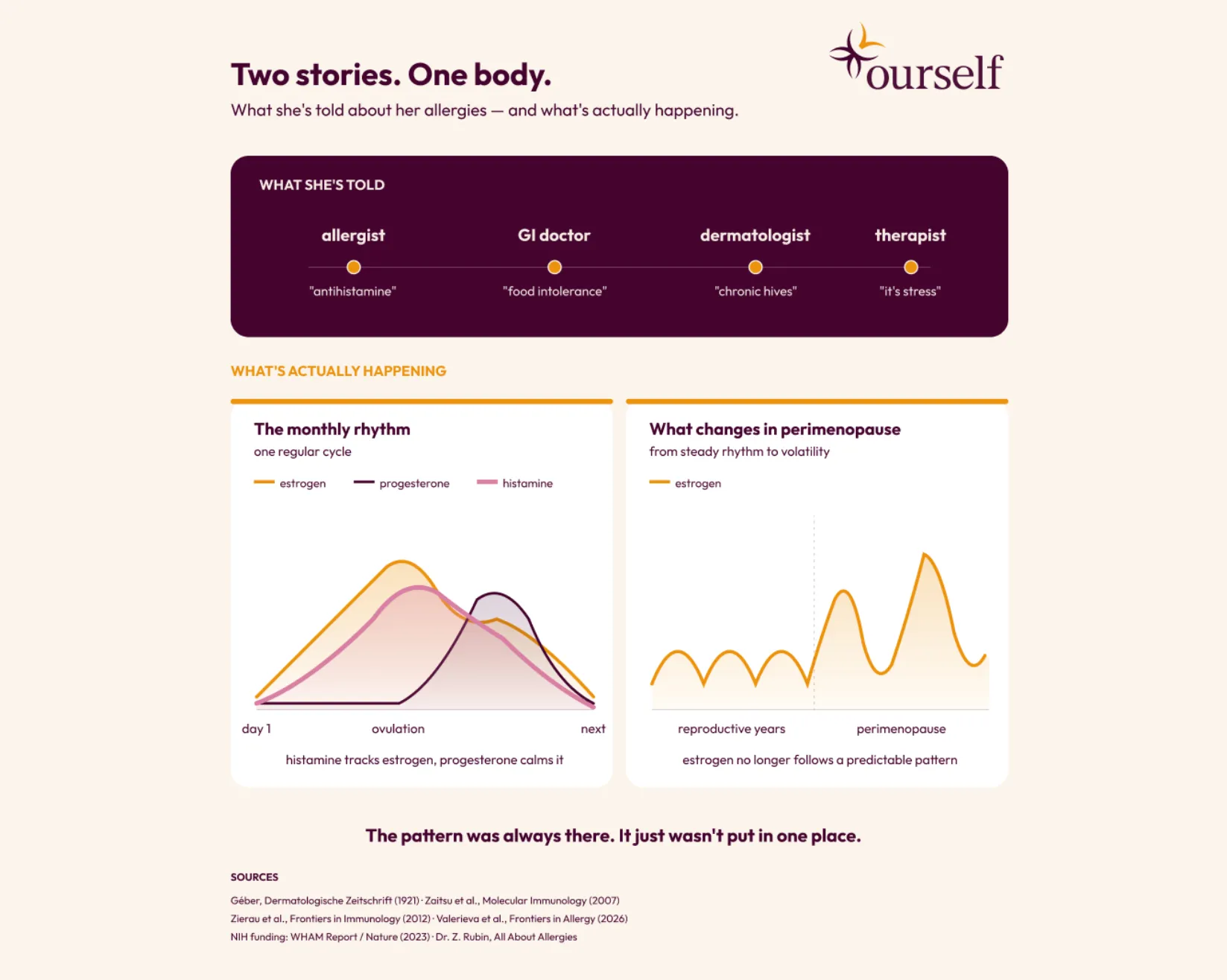
This isn't new science. As early as 1921, a physician described hives that flared with the menstrual cycle. The timing isn't random. When estrogen rises, like it does around ovulation, it can increase histamine release and slow how quickly it's cleared. When progesterone rises, it acts as a brake. That pattern repeats monthly, cycle after cycle, whether or not you can clearly see it.
Hormones Shift at Every Stage, From Cycles to Perimenopause
Hormones don't just matter at one stage of life. They shift continuously and show up differently in each stage, across cycles, across years, and across transitions. During perimenopause, for example, estrogen becomes more erratic while progesterone, the stabilizing counterbalance, declines. For many women, that's when patterns that were once subtle become more noticeable, disruptive, and harder to ignore.
The Evidence Is Catching Up to the Biology
A 2026 review in Frontiers in Allergy pulled together evidence on how changes in estrogen and progesterone can reshape immune responses and intensify certain hypersensitivity and allergic conditions. Clinicians like Dr. Zachary Rubin, an allergist-immunologist who has been vocal about the role of hormones in allergy and histamine responses, have been bringing this biology into the public conversation, making it clear that while the clinical evidence is still evolving, the underlying mechanisms are well documented.
How Ourself Helps You See Your Patterns Now
This is exactly why we built Ourself. Because while research catches up, or becomes easier to access and connect, you shouldn't have to wait. Your body is already generating data. The patterns are already there.
Ourself tracks your symptoms alongside your hormone cycle, helping you see what might otherwise stay invisible. And Stella, our AI assistant, connects your personal data to the science that does exist today, so you can start making sense of what you're experiencing now.
No PhD required.