Does an early first period raise your heart disease risk?


Adriana Torosian is the founder and CEO of Ourself Health, a women’s health app that helps women track, understand and act on how their hormones shape their health. She previously spent 20 years building businesses at Google, Microsoft, and writes about women’s health in her Substack, Everything Connected.
Women who got their period at age 11 or younger have a higher risk of major cardiac events – think heart attack, stroke, heart failure – than those whose first period came around 12 or 13. A large meta-analysis of nearly five million women found the same pattern: the earlier menarche happens, the higher the long-term cardiovascular risk.
Genetic studies have gone further, finding that earlier menarche causally raises the risk of coronary artery disease, heart failure, atrial fibrillation, and stroke – not just correlation, and actual causal line.
Sit with that for a second. A single data point from puberty, something most of us never thought of again, is quietly shaping cardiac risk forty, fifty years later. And almost nobody is told this; not at 11, when it might still be useful context, nor at 30 when a doctor is reviewing risk factors. In fact, not even at 50, when heart disease becomes the conversation everyone’s supposed to be having.
Why doesn’t anyone know this?
Not because the research doesn’t exist. It does, some of it going back over a decade. But it’s that heart disease is still talked about, trained for, and screened for using a male template: chest pain, left arm, collapse.
Reproductive history, however, including menarche, pregnancy complications, age at menopause, isn’t part of the standard cardiac risk conversation most doctors are trained to have – even though it’s some of the most predictive information a woman’s body has been generating about her since adolescence.
So, a woman can walk into a cardiology appointment in her 50s, list every risk factor on the standard form, and never once be asked the one question that might actually move the needle on her individual risk. Her doctor isn’t incompetent. The form, the training, and the guidelines were never built to ask for it.
This is the same story I keep coming back to in different bodies, symptoms, and decades of a woman’s life: the information exists. It’s just never been organized into a system that connects it to anything.
This is why I say hormones are everything
Not as a slogan. As a literal description of how the body works. Your hormones aren’t a subplot that shows up once a month and otherwise stays out of the way; they are the chemical messengers running between essentially every system you have – cardiovascular, metabolic, neurological, immune. Estrogen alone has receptors in your heart, blood vessels, bones, brain and skin.
It’s not “reproductive health” in the narrow sense most people mean when they hear the word. It’s structural to almost everything else.
That’s why a thing that happened to you at 11 can still be quietly relevant at 55. Why your sleep last week shifted your cycle this week. Why a thyroid issue can look like depression.
Medicine, as it’s currently built, mostly doesn’t track any of this as connected. It tracks organs, specialties, the loudest symptom in the room on a given day.
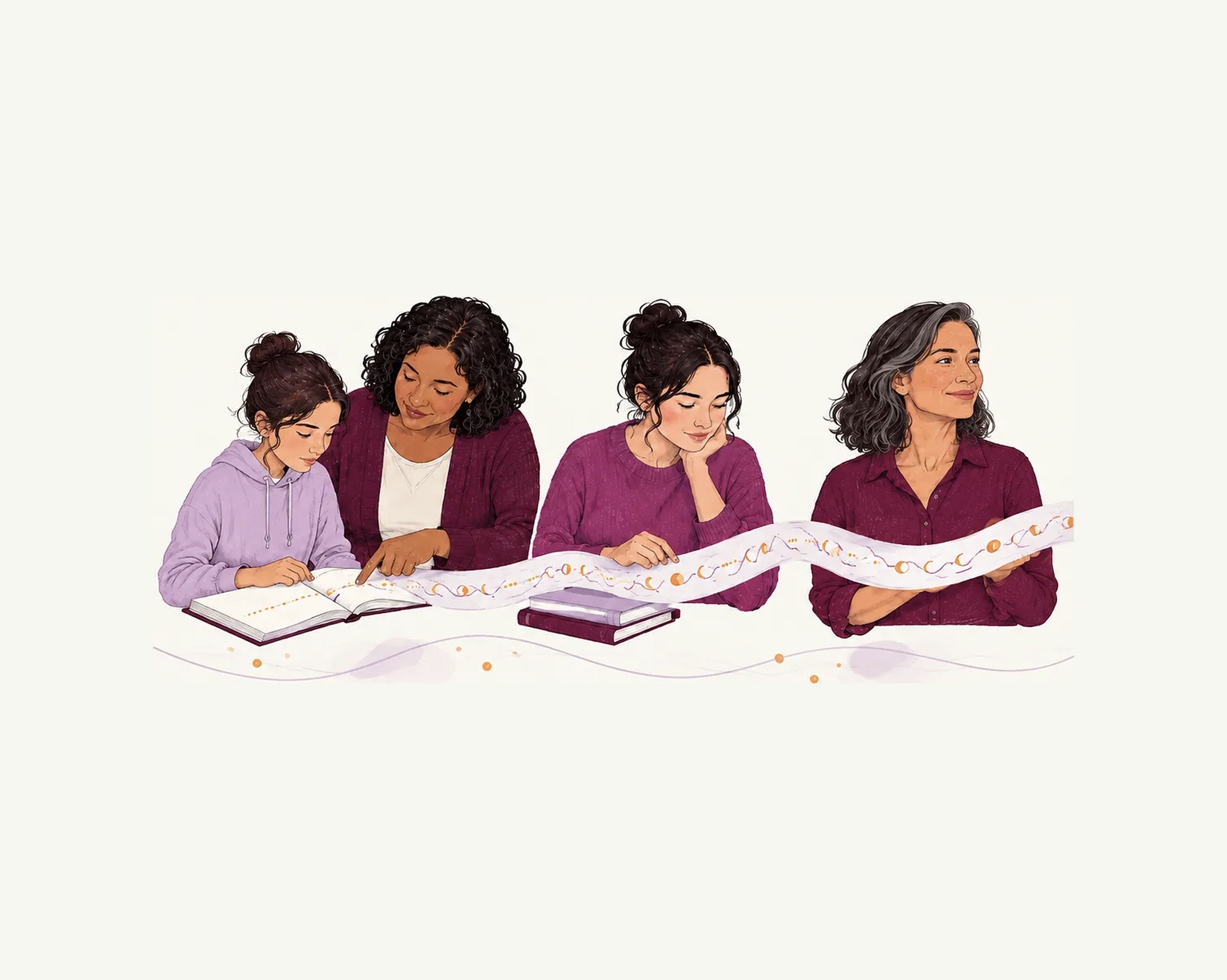
What it doesn’t do – and what almost nothing in the current system is built for – is hold a woman’s full hormonal timeline and ask what it’s been quietly predicting the whole time.
That’s the gap we must name clearly, instead of letting it stay buried in a journal article almost no one outside research ever reads: the data about how connected hormones are to everything already exists. It’s just never been assembled into something a woman (or her doctor) can actually use.
Today, I want that fact to sit with you as something more than trivia: the age you were when you got your period is part of your cardiac risk story, whether anyone has ever written it down or not. The problem isn’t that your doctor forgot to ask; it’s that the entire system was built without a place for your hormonal timeline, as if it were optional to understanding your heart. That has to change. Remembering your first period, and insisting that it belongs in the conversation, is one way we start rewriting the template.
— Adriana