Why are girls' periods
starting earlier?


Adriana Torosian is the founder and CEO of Ourself Health, a women’s health app that helps women track, understand and act on how their hormones shape their health. She previously spent 20 years building businesses at Google, Microsoft, and writes about women’s health in her Substack, Everything Connected.
Every day, at pediatric checkups across the country, girls stand against the wall to be measured, then step on the scale, and both numbers go on a growth chart. If a girl’s line starts to drift, someone notices. That chart follows her for years, from appointment to appointment and from one pediatrician to the next.
Her first period gets no chart. Usually it’s one answer to one question, if anyone asks at all. After that, it tends to disappear from the record.
This isn’t what the guidelines say should happen. In 2015, the American College of Obstetricians and Gynecologists recommended treating the menstrual cycle as a vital sign in girls and adolescents and, once a girl has started her period, asking about it at every preventive or comprehensive visit. Their reasoning was simple: a girl’s cycle can reveal problems early, and girls may not realize their own bleeding patterns are abnormal.
More than a decade later, it still hasn’t sunk in. In a review of nearly 1,000 well-visit records in New Jersey, fewer than 1 in 10 pediatricians documented a complete menstrual history. In a national survey, about a third of pediatricians said they don’t routinely discuss periods with girls who have started them. And the official schedule that guides U.S. checkups lists height, weight, BMI and blood pressure. The menstrual cycle isn’t on it.
I saw what that gap looks like up close. When we were building Ourself: Cycles and Hormones, I interviewed women about their own cycles and hormones. They had plenty to say, and many were glad someone had finally asked. But a consistent shift kept happening. Halfway through, they would pause and bring up their daughters. They were deeply worried that their girls had started their periods so early, at 11, 10, 9 and even 8. That was years earlier than these mothers had expected, and often years earlier than they had started themselves.
Most were searching, sometimes for years, for someone to take the question seriously. Each of them sensed, in the way a parent knows her own child, that this was not how it was supposed to go. When they asked, they usually got one of two responses: nothing useful at all, or a reassurance that closed the conversation. Girls develop earlier these days. She’s healthy otherwise. There’s nothing to worry about.
None of that explained anything. Early periods are becoming more common across younger generations, but more common isn’t the same as harmless. And the question those mothers were asking still doesn’t have a clear answer.
Join for free for a new essay each week
The clock is moving
In a Harvard-led study of more than 71,000 people in the U.S., participants born between 2000 and 2005 reported getting their first period at an average age of 11.9. Among those born between 1950 and 1969, the average was 12.5.
Half a year sounds small until you look at the youngest girls. The share reporting a first period before age 11 nearly doubled, from 8.6% to 15.5%. The share reporting one before age 9 more than doubled, from 0.6% to 1.4%. Some of those girls are in second or third grade.
The finding isn’t confined to that U.S. study. Research published in 2026 found a similar shift in Spain and China. In Spain’s Valencian Community, a study of more than 417,000 people found first periods arriving nearly two years earlier over eight decades. For girls born since 1990, it drew on records made during childhood and adolescence. The Chinese study asked girls whether their periods had already begun. Neither depended entirely on adults remembering an event decades later.
And the first period isn’t where puberty starts. Breast development usually comes first, and it has been moving earlier too: by almost three months per decade, according to a review of studies conducted between 1977 and 2013.
In June, the Endocrine Society released its first guideline on central precocious puberty, when the brain triggers puberty before age 8 in girls or 9 in boys. One of its co-chairs, Dr. Stephanie Roberts of Boston Children’s Hospital, said clinicians are seeing more of it in both boys and girls, and that puberty overall is starting earlier.
And it doesn’t end with the first period. In the U.S. study, about three in four women born in the 1950s and ‘60s said their periods became regular within two years of their first one. For those born in the early 2000s, it was just over half.
Those are the years when a painful, heavy or erratic cycle is easiest to wave off as normal for her age. Some of it is. Irregular cycles are common in the first few years. But bleeding that lasts longer than a week, soaks through protection, or pain that keeps her home from school can be the first sign of something worth paying close attention to, including bleeding disorders, thyroid disease or polycystic ovary syndrome. Without a record, those patterns are harder to recognize.
Not every girl is starting in the same place, either. In the U.S. study, the shift toward earlier periods was more pronounced among non-Hispanic Black and Asian participants, those identifying with other or multiple races, and those reporting lower socioeconomic status.
Every explanation is partial
Ask why this is happening, and you’ll get a list.
Childhood weight usually comes first. Body fat and metabolic signals help influence when puberty begins. In the U.S. study, researchers estimated that BMI could account for about 46% of the shift toward earlier periods. That’s a lot, but it suggests weight alone doesn’t explain the whole trend.
Chemicals come next, and the evidence is mixed. An NIH team screened roughly 10,000 compounds and found that musk ambrette, a synthetic fragrance ingredient, could activate puberty-related signaling in cells and zebrafish. That’s a lab finding, not proof that everyday exposure causes earlier puberty in girls.
Studies in people don’t line up either. Some chemicals have been linked to earlier puberty, including a fragrance compound and triclosan in one California study and a fungicide residue in a Spanish one. Others, like PFAS, the so-called forever chemicals, have been tied to later puberty. A 2022 analysis pooling dozens of studies found no consistent pattern. We don’t yet know which exposures matter.
Then there’s stress. Early-life abuse has been linked to earlier first periods, but a British study of 4,524 participants found cumulative childhood hardship associated with later ones. Different kinds of adversity seem to push in different directions.
The pandemic added another clue. Across 22 medical centers in China’s Henan province, recorded new cases of precocious puberty between February and May 2020 were five times higher than in the same months of 2018. Children’s routines had changed dramatically, but the study couldn’t say why.
These aren’t necessarily competing theories. They may be pieces of one system. A Columbia-led study published in April looked at them together. Girls with higher stress-hormone levels, higher BMI and more stress at home began breast development about seven months earlier than girls with low levels of all three. It was observational, not proof of cause, but it showed why studying these factors one at a time leaves us with partial answers.
What we need is research that looks at them together, over time, starting in childhood.
Why the timing matters
Those mothers had good reason to worry. Timing carries information, and some of it shows up decades later.
Even the newest clinical guidance favors watching closely before testing. For girls who start developing breasts between ages 7 and 8, the Endocrine Society’s guideline suggests seeing a doctor every four to six months to track how fast she’s growing and how quickly puberty is moving, rather than ordering blood tests or scans right away. If puberty is moving quickly, the guideline says that’s when testing should begin.
A 2014 meta-analysis found that women whose first period came before 12 had a 23% higher relative rate of death during follow-up than those whose periods began at 12 or older, though that comparison drew on only two cohorts. Earlier periods are also associated with higher type 2 diabetes risk, even after accounting for adult body weight. And a large pooled analysis found about a 5% higher relative risk of breast cancer for each year younger a girl was when her period started.
These are population-level associations, not predictions of what will happen to any individual girl.
Writing about the U.S. findings, Lauren Houghton, the Columbia epidemiologist who led the stress and puberty study above, argued that they strengthen the case for treating menstrual health as a vital sign. I agree. These associations make early menstrual history worth understanding, not a childhood moment to note once and forget.
And then, crucially, there is mental health.
In one UK cohort, girls whose periods began before 11.5 had the highest depressive symptoms at 13 and 14. A genetic analysis suggested that earlier menstruation may contribute causally to depressive symptoms at 14. A later study found the gap had largely narrowed by 24.
To me, the gap narrowing doesn’t make those early years less important. It makes early adolescence a period when girls who mature ahead of their peers need particular attention and support.
Yet we often leave them poorly prepared to talk about what’s happening, or to know when and how to ask for help.
In interviews with 70 women in South Carolina, Purdue researchers found that most had received little meaningful preparation before their first period, and clinicians rarely featured in those conversations.
In a study of young women in England, participants described leaving school without knowing enough to recognize when symptoms warranted help. One, later diagnosed with endometriosis, said it would have helped to be taught what was not normal, and that cramps weren’t something to just push through.
If we wait for them to bring it up themselves, many will spend years assuming what they’re going through is normal, and suffering through it in silence.
What we’d see if we kept the record
The part that frustrates me the most is how little of this is ever recorded. A date, maybe, if someone asks. Almost never a history.
One of the largest recent U.S. studies on this trend asked adults to recall their first period, sometimes decades later. It’s remarkable research, and it has helped us understand how menstrual timing is changing.
It’s also built on memory.
And think about the moment we’re asking them to remember. For many girls, a first period arrives without enough preparation, practical information or support. It can be frightening or confusing, a bodily change they knew might happen but weren’t ready to manage.
Writing down the date is hardly the first priority.
Years later, the memory may be of a school bathroom, a summer holiday, or the person they went to for help. The age is something they piece together from there.
Newer research in Spain and China has captured menstrual timing closer to when it happens. That strengthens the evidence that the shift is real. But it still isn’t the same as a dated history, beginning with the first period and following the cycles and symptoms that come after.
For now, that record often starts at home.
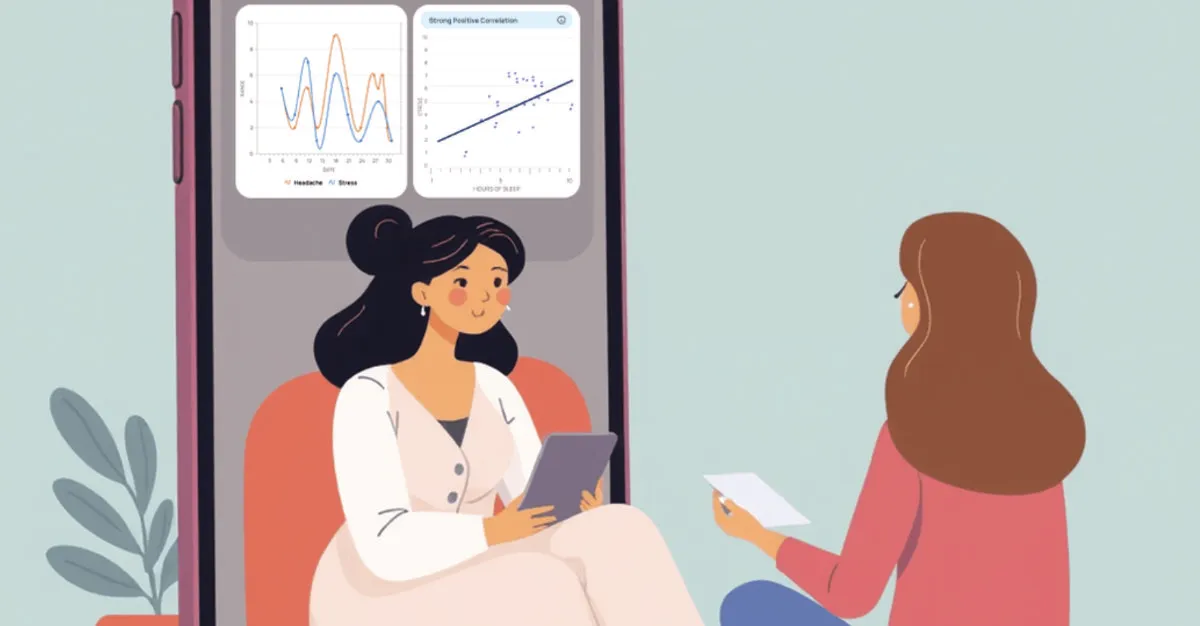
A parent can help their daughter write down the date of her first period and every one after it. Together, they can note pain, heavy bleeding and mood, and the context around them, like a bad stretch of sleep, a stressful move or a growth spurt. As she gets older, she can take the lead in deciding how to keep that history and what she wants to share.
It sounds small. It isn’t. A dated record can turn “she’s always had heavy periods” into “her periods got heavier the year she started a new school.” That doesn’t establish why the change happened, but it gives a clinician a clearer timeline to investigate.
But it shouldn’t rest on parents alone. Pediatricians can ask about a girl’s period at every checkup, as the guidelines already say, and record it the way they record her height. Health systems can build it into the chart and the checkup schedule. And researchers can follow girls from before their first period, instead of asking women to remember it decades later.
Now picture that kind of record across thousands of girls, kept from the very first period, with their privacy protected. Weight, sleep, stress, exposures, cycles and mood, captured as they happen instead of remembered decades later.
We may finally learn which pressures matter most, for which girls, and when. We might learn which early patterns point to diabetes, or depression, or nothing at all.
We already chart a girl’s height and weight like they matter. And they do. Her hormones are telling us something, too. An earlier first period is one of those signals, and we still don’t fully understand what it means.
That won’t change on its own. It starts with treating a first period not as a passing moment, but as what it is: a vital sign.