Why the six-week postpartum checkup isn't enough

Adriana Torosian is the founder and CEO of Ourself Health, a women’s health app that helps women track, understand and act on how their hormones shape their health. She previously spent 20 years building businesses at Google, Microsoft, and writes about women’s health in her Substack, Everything Connected.
The six-week question nobody asks
At the six-week postpartum checkup, a doctor checks your stitches. Your weight. Your blood pressure. They ask about birth control. And in about fifteen minutes, you’re cleared to go back to your normal life as though nothing about you has fundamentally changed.
Not enough people ask if you’ve slept more than two hours at a stretch since the birth, or if you’ve been crying in the shower where nobody can hear it, or if a thought crossed your mind once that scared you enough that you never repeated it to anyone.
There isn’t really a place on the form for that. So you say you’re tired, and you go home, and the appointment counts as a success.
Every woman I know has heard some version of this. And it’s rarely the dramatic version. Usually, it’s the friend, co-worker, sister, who knew, somewhere underneath the exhaustion, that what she was feeling had gone past ordinary new-mom tired, and just didn’t have anywhere to put that knowledge.
Six weeks was never designed to catch it. Neither, as it turns out, is most of what comes after.
A verdict that wasn’t one
A Massachusetts jury spent seven days deliberating and still couldn’t reach one, so the judge declared a mistrial in the case of Lindsay Clancy, the mother whose defense argued postpartum psychosis was behind her children’s deaths in 2023.
I’m not going to weigh in on guild here, because that’s not mine to decide and honestly, it isn’t the part I keep thinking about.
What keeps circling in my head is how supporters packed the courthouse and “she needed help” spread across social media faster than I’ve ever watched a maternal mental health message travel in years. Beyond individual sentiments, the case has put maternal health and postpartum care at the center of conversations worldwide.
This tells me something has genuinely shifted in how this gets talked about publicly. Not too long ago, I bet, the case would have gone under the radar, Clancy labeled as crazy or deranged much quicker than the jury deliberated.
That took decades to get even this far, and it’s worth acknowledging as real progress rather than taking it for granted.
And then, there’s the other half of it. Clancy had been seen by more than a dozen psychiatric and medical providers and prescribed 13 different medications in the four months before it happened.
Thirteen medications, over a dozen providers, and the system still didn’t catch what was coming.
That’s a harder problem than any verdict could have settled, because it isn’t about whether anyone was paying attention. Clearly, some people were. It’s about whether paying attention is enough when the follow-through isn’t there.
What’s actually rare, and what isn’t
It’s worth separating two things here, because folding them together doesn’t help anyone understand either one better.
Postpartum psychosis, the condition Clancy’s defense described, affects 1 to 2 out of every 1,000 births, according to ACOG. It’s rare, and it’s a genuine medical emergency when it happens, and the overwhelming majority of women who go through it never hurt anyone.
It often shows up fast, usually within the first two weeks after birth, but the risk doesn’t end there — people remain at risk for the first year after delivery. It tends to look like a break from what’s real; hearing something that isn’t there, seeing something that isn’t there, holding onto a belief that has no basis in fact and won’t budge no matter what anyone says.
It can come with racing thoughts, barely sleeping and not seeming to need it, agitation that wasn’t there before, or a confusion that makes someone seem like a different person for stretches at a time.
One detail clinicians point to often: it can come and go, with real lucid moments in between, which is part of why it’s so easy for the people closest to her to miss or explain away.
None of that is something to wait out until the next scheduled appointment. It is, indeed, a psychiatric emergency that calls for immediate hospitalization, an emergency room or a 911 call, not a wait-and-see. Someone should stay with her until she’s in professional hands.
Underneath that rare extreme sits something much more common. About 1 in 8 mothers in the U.S. will experience postpartum depression, and plenty more will deal with anxiety or intrusive thoughts or simply not recognizing the person looking back at them in the mirror – without ever mentioning it to a doctor.
Let me be clear here: if you’ve gone through this, or currently experiencing it, this does not mean there is something wrong with who you are. Estrogen and progesterone fall faster in the days right after birth than at almost any other point in a woman’s life, and that’s happening at the same time as no sleep, blood loss, a body you don’t quite recognize, a newborn who seemingly needs rescue from the world and themselves 24/7.
Add to that an unspoken expectation that you’re supposed to be glowing through the whole thing.
The quiet part
Suicide is a leading cause of maternal death in the first year after birth, and the same detail keeps showing up across studies of it. Many of the women who died hadn’t seen a mental health professional in the month before.
It isn’t usually that help was unavailable on paper. More often, by the time it’s visible enough to notice, a woman has already been carrying it alone for weeks, telling herself that saying it outloud is admitting she’s failing at the one job she isn’t allowed to fail at.
That part has nothing to do with any courtroom. It’s the six-week checkup where the honest answer never makes it out of your mouth, because the alternative feels less like disclosure and more like confession.
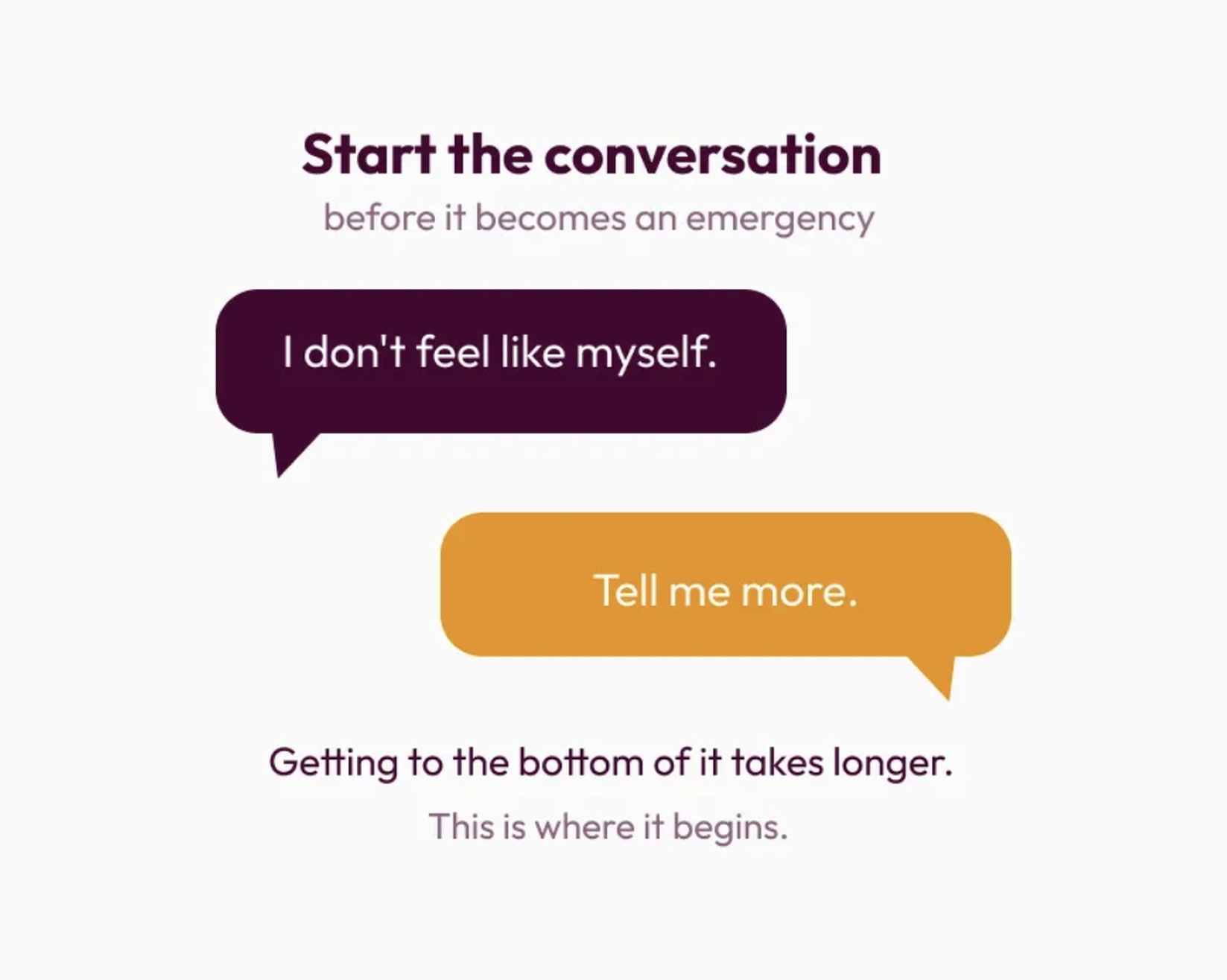
Start the conversation
Today is World Suicide Prevention Day. This year’s theme from the WHO and the International Association for Suicide Prevention is “Changing the Narrative on Suicide”, built around a call to action that’s really just about starting the conversation before it’s too late.
For postpartum care specifically, that means screening that doesn’t stop at six weeks, since that’s rarely when this actually shows up. It means treating “I don’t feel like myself” as a clinical flag worth following up on rather than something to nod along to on the way out the door.
Mostly, it means making room for a mother to say the hard sentence out loud before it becomes an emergency instead of after.
Women’s health was never one system to begin with. It’s hormones and sleep and history and whoever happens to be in the room asking the follow-up question – or not asking it.
Everything is connected, and right now, too much of that connection is missing in exactly the places it matters most. For our mothers. For our women.
If you or someone you know is struggling:
National Maternal Mental Health Hotline, call or text 1-833-852-6262
Postpartum Support International Helpline, call or text “Help” to 800-944-4773
988 Suicide & Crisis Lifeline, call or text 988
Take care. I believe in you, and I believe the system can be better.
—- Adriana