Why do women use AI less than men? Caregiving is a big reason

Adriana Torosian is the founder and CEO of Ourself Health, a women’s health app that helps women track, understand and act on how their hormones shape their health. She previously spent 20 years building businesses at Google, Microsoft, and writes about women’s health in her Substack, Everything Connected.
More than a decade ago, a generation of women were told to lean in. Sheryl Sandberg’s book promised that the seat at the table was there for anyone bold enough to take it, and plenty of women tried. Many of them also found out what the advice left out: leaning in assumes someone is home with the kids while you lean.
Women are using AI less than men, across almost every country and profession surveyed so far. A Harvard Business School working paper pooling data on nearly 320,000 people from more than 100 countries found men are about 22% more likely than women to use generative AI tools like ChatGPT. The gap has narrowed since ChatGPT’s launch, but it has held at roughly 16% since early 2025. In the U.S., the gap in simply trying these tools has nearly closed, but men still use them more often, and more for work. The real question—and the one I want to spend time on—is why.
Plenty of talented young women at big tech companies have lived the gap Sandberg’s advice left out. They work hard, take on stretch projects, raise their hands in meetings. They have children, do the math on childcare, and realize their salary doesn’t cover it.
Out of options, many of them quit. They don’t lack ambition or ability. They lack a system that makes staying possible.
The conversation about AI is repeating the same mistake. Women are using these tools less than men, the story goes, so they need to be more curious, more confident, more willing to experiment.
Sure, some of that may help. But it treats a structural problem as a personal one, exactly as “lean in” did, and it still assumes the best women can hope for is a chair at someone else’s table, when what they need is to be at the head of it.
Look closely at why women are falling behind and the missing ingredient is usually time, along with a technology largely built by people who have never had to fit their own learning around a nap schedule.
Women use AI less, even when access is equal
The gender gap in AI adoption shows up almost everywhere researchers look. In the Harvard analysis, it appeared in 56 of the 58 sources that reported usage rates for men and women. Early on, the gap was starker: between May 2023 and November 2024, only about 27% of ChatGPT app downloads came from women.
It also persists between people doing the same work. Research from the University of Chicago and the University of Copenhagen, using data from Statistics Denmark, found women were 16 percentage points less likely than men to use ChatGPT for work tasks, and the gap held even among workers in the same occupation.
The clearest test of the access question came from an experiment, not a survey. Harvard researchers invited around 17,000 entrepreneurs in Kenya to use ChatGPT and showed them how. Women were still about 13% less likely to try it. Kenya is a long way from a U.S. daycare line, but the design is what matters: when everyone got the same invitation and the same instructions, the gap didn’t close.
Scholars offered several explanations: women report less familiarity with AI tools, less confidence using them, and less persistence, meaning they’re less likely to keep re-prompting until they get a useful answer. They are also more likely to see AI use at school as unethical or a form of cheating, and, as Harvard’s Rembrand Koning has noted, to worry about being judged for relying on it at work.
Read that list as a working mother would. Persistence with a chatbot means sitting with it, testing prompts, getting it wrong, and trying again. That’s easy enough for a grocery list, where a bad answer costs nothing.
At work, there’s a learning curve before the trial and error even starts: figuring out what the tools can do, which tasks to hand them, and how to ask. Few employers make room for any of it. In the Danish study, workers said they were often held back by employer restrictions and a need for training they weren’t getting. That pushes the practice into evenings and weekends, exactly the hours that don’t exist for the more than 24 million U.S. mothers in the workforce with kids under 18.
The cheating worry is a work problem, too. No one asks how a meal plan got made. But a woman who leaves at 5 p.m. for daycare pickup can’t afford to have anyone wondering how her report got done.
The childcare math behind the AI gender gap
AI skills take time to build, and in most families childcare decides how much time women have, and often whether they can keep working at all. In the U.S., care now costs about as much as a second rent payment; according to Child Care Aware of America, the national average annual price of childcare was $13,184 in 2025, or about 10% of median income for two-parent households and 33% for single parents.
When that math doesn’t work, women are usually the ones who absorb it. In the first half of 2025 alone, labor force participation among U.S. mothers of children under five fell by nearly three percentage points, reversing years of gains. KPMG’s analysis points to two pressures: childcare that got more expensive and harder to find after pandemic-era federal funding ran out, and return-to-office mandates that took away the flexibility many mothers relied on. Among college-educated mothers of very young children, participation dropped to 77% in August 2025 from close to 80% in 2023, while fathers with very young kids saw slight increases.
The data points to childcare and rigid schedules, not a lack of AI skills, as the reason these women are leaving. But the same childcare gap hurts women on both sides of that line. Those who stay bend their careers around their families, turning down travel, stepping back from promotions, pausing to support a child’s needs, and have little time left to learn new tools. Those who step away lose the workplace where those tools are being put to use, and with childcare still out of reach, the path back gets harder as AI becomes standard.
The load doesn’t end when the baby sleeps through the night, either. Postpartum recovery often lasts far longer than the six-week checkup suggests, with effects on hormones, sleep and mood that can stretch on for years. And for many women, the years of raising young kids run straight into the start of perimenopause.
All of it draws on the same limited pool of time and energy that learning a new technology requires.
It’s not just childcare
Childcare is just the part of the load people can picture. According to AARP and the National Alliance for Caregiving, 63 million Americans now care for an aging parent, a spouse, or a family member with a serious illness or disability. That’s about one in four adults, and roughly six in ten of them are women. Nearly a third are sandwiched, raising children while also caring for an adult.
This kind of care doesn’t run on a schedule. A fall, a new diagnosis or a hospital discharge on a Tuesday afternoon doesn’t come with a pickup time, and seven in ten family caregivers are also holding down a job. The evenings that go to coordinating appointments and refilling prescriptions are the same evenings someone else spends learning to use a chatbot.
What’s holding women back
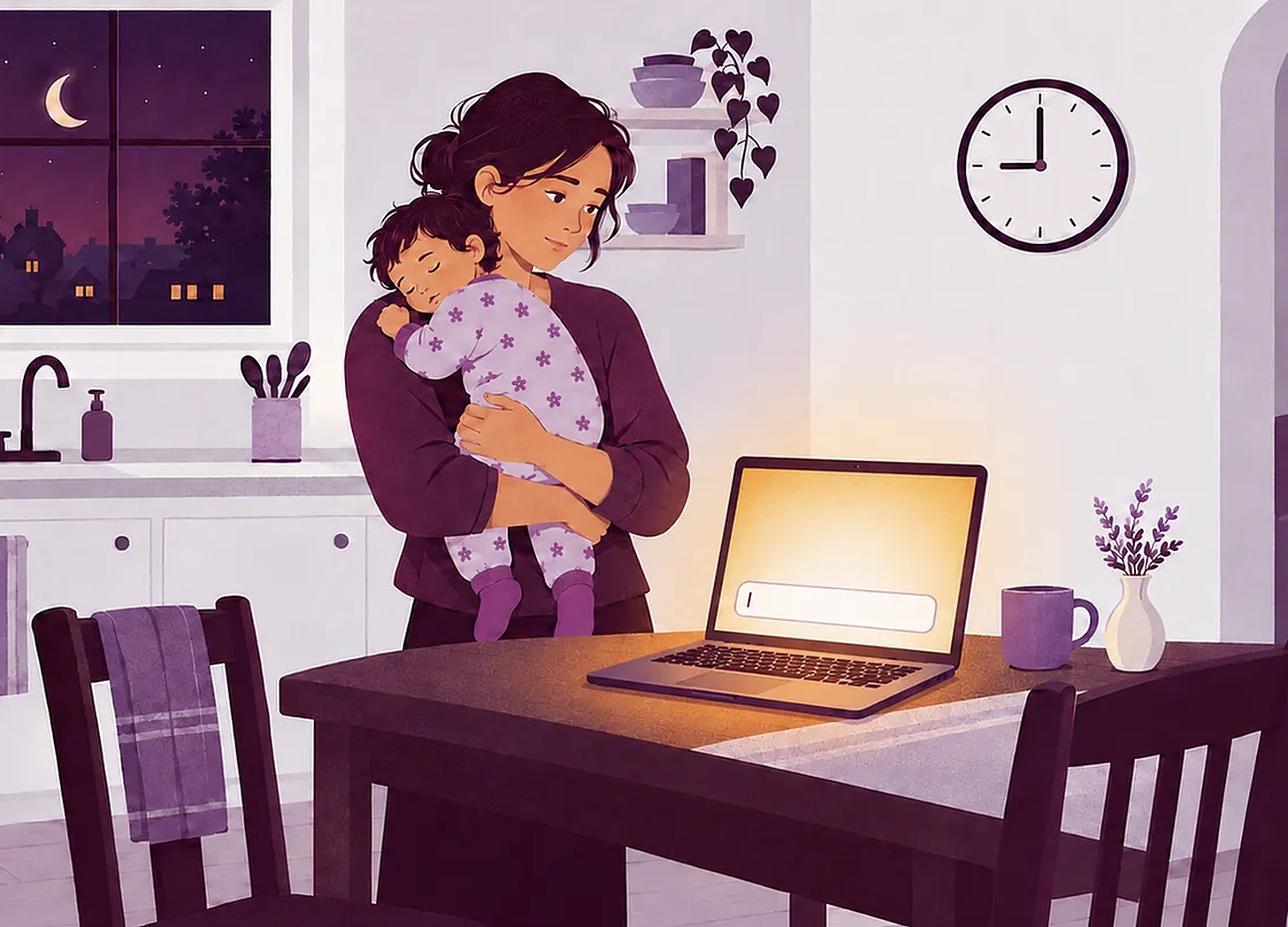
AI has a timing problem. It promises to save time, but only after an up-front investment in learning it. For someone with free evenings, that trade is easy, but for someone whose evenings belong to someone else—a toddler’s bath, a teenager’s homework, a parent’s pill organizer—the up-front cost can be the whole barrier.
A 2025 World Economic Forum report named unpaid care as one of the main reasons women can’t take part in AI upskilling or reskilling, according to an analysis from the Observer Research Foundation, because heavy care responsibilities shrink the time available to learn. ORF’s researchers warn that AI transitions will leave women out unless they come with subsidized childcare, flexible work, and accessible training.
Perceived usefulness matters, too. In a study of German employees presented this year at the Hawaii International Conference on System Sciences, women reported lower intentions to use generative AI and, in a one-week diary, spent about 17 minutes less a day using it than men. The strongest predictor of whether people planned to use the tools was whether they expected them to improve their work, and that was especially true for women: they’re more likely to use AI when they expect it to pay off.
You can see this in how women are using AI now. In the U.S., women had nearly caught up with men in ever using a chatbot by early 2026, 47% to 50%, according to Pew Research Center, but men were still more likely to use one daily and to use it for work. At home, AI is already absorbing care work: in a Lurie Children’s Hospital survey of more than 1,000 U.S. parents, 81% had used it for parenting tasks like meal planning and health questions, and two in three said it lightened their mental load. At work, the payoff is harder to see, and it only comes after a learning curve that few women have the time to climb. When the time savings sit on the other side of time you can’t spare, skipping it isn’t hesitation. It’s math.
So, when a woman juggling work and caregiving says she doesn’t have the time to “figure out ChatGPT,” she is usually telling the literal truth. Calling that a confidence problem puts the burden back on her.
The longer the gap lasts at work, the harder it gets to close. At home, a chatbot pays off on the first try, and no one grades the meal plan. At work, it takes hours to learn and the results get judged, and without training or time to practice, the gap keeps widening. Mothers are also far less hopeful about what AI means for their futures: in a 2025 Capita/YouGov surveyof U.S. parents of young children, 45% of mothers saw it as a threat to their family’s financial well-being, and only 13% expected it to help, half the share of fathers. Women also report feeling more intimidated by AI tools than men, 47% versus 33% in one 2026 Canadian survey.
From the outside, that can look like women opting out. Some might. But for women juggling work and care, the decision is often made for them. When the training never comes and childcare is out of reach, whether a woman stays in her job or steps away from it, catching up starts to feel impossible. And when you don’t believe you’ll ever catch up, it’s hard to keep trying.
The consequences also reach beyond individual careers. Harvard describes a self-reinforcing cycle, whereby if women stay underrepresented among AI users, the systems get trained on data that poorly reflects women’s preferences and needs.
Women’s health has seen this before. Medicine spent decades treating the male body as the default. In 1977, the FDA barred all women who could become pregnant from early clinical trials, and women are still paying for the gaps that left. AI risks repeating that pattern if the women it should serve are too busy caring for everyone else to show up in the data.
Why the gap matters, and how to close it
Even the cost of sitting AI out won’t fall evenly. A 2025 study from the International Labour Organization found that in high-income countries, the jobs most exposed to automation by generative AI make up 9.6% of women’s employment, nearly three times the share for men.
Many of those roles are clerical and administrative, built on tasks like scheduling, data entry and document formatting that AI can already handle. The ILO expects most of these jobs to change rather than disappear, making the adoption gap more urgent. After all, the people who already use these tools will have the most say in how their own jobs get redesigned, and right now fewer of them are women.
Employers are best placed to close that distance, and they have more control than they think. Paid learning time during work hours does more than any optional lunch-and-learn scheduled against daycare pickup. An AI training budget matters, but it goes further when it comes with childcare support, and clear policies help as well.
Economist Anders Humlum has recommended that employers set clear guidelines on appropriate AI use, along with hands-on training, to boost adoption and narrow the gaps between workers. Once a company says plainly that using AI is allowed and expected, the fear of being seen as cheating loses much of its grip.
Women are also finding their own ways in, often through each other. Small groups where women learn AI from other women tend to work in formats that fit around a care schedule: short sessions, shared examples, permission to ask basic questions without being judged for them.
Learning alongside people with the same constraints can also make the up-front time feel less like a gamble. Starting with one task that already eats into the evening, whether that’s meal planning, a work summary or a stack of school emails, keeps the investment small enough to fit—and relevant enough to test.
The studies so far mostly measure the gap, not the care load behind it. That’s the part I want to understand better, and this piece is the start of a longer project I’m working on about women, AI and care work.
AI could be one of the best tools women have ever had for getting time back, from the meal plans and school emails at home to the research, analysis and first drafts at work. It’s also fast becoming part of how work gets done, and women won’t reach parity at work if they’re learning it years after the men beside them. If AI is going to give women their time back, and a fair shot at work, they first need the time to learn it and a reason to believe they can catch up. That’s a job for employers making room for training at work and policymakers making care affordable, not one more thing for women to squeeze in after bedtime.
—Adriana